
The Role of Milling in Making Decorative and Functional Wooden Parts
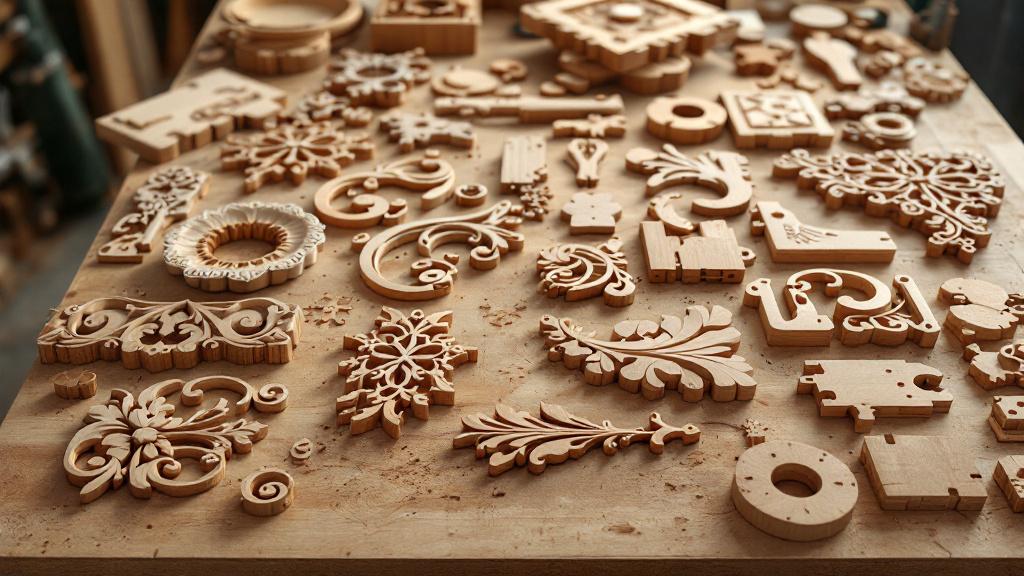
Wood is a material that people have been using for thousands of years. It is valued for its natural beauty, warmth and strength. To turn an ordinary piece of wood into a work of art or an indispensable interior element takes skill and, of course, modern technology. One of the key operations in our work is milling. This is not merely the removal of excess material; it is a high-precision, flexible and creative process that makes it possible to breathe life into a wooden blank, giving it the required shape, profile and functionality.
Milling as the Basis of Shaping in Woodworking
Milling is the machining of wood in which material is removed by a rotating multi-blade tool called a cutter. In the woodworking industry this technology holds a central place, making it possible to create products with high precision and repeatability, which is critically important for serial production and complex joinery work.
The milling process transforms an unmachined blank into an element with clearly defined geometric parameters. An initially flat or rectangular bar, thanks to milling, acquires complex contours, curved edges or internal grooves. This applies both to solid timber and to composite materials such as MDF or plywood.
With milling you can perform a wide range of tasks. These include levelling surfaces, profiling edges to give them a decorative appearance, and cutting grooves for joints or for installing hardware. Milling makes it possible to work on parts in three-dimensional space, which opens the way to producing shaped elements.
It is worth noting that milling provides a far greater degree of freedom in design compared with other processing methods, such as sawing or planing. Where a saw can create only a straight line, a cutter is capable of cutting almost any given profile.
For us, milling is the bridge between the designer’s idea and the finished product. The precision provided by modern computer numerical control (CNC) milling machines guarantees that every element will match the drawing with minimal deviation. This is especially important in the manufacture of complex assemblies, where even the slightest inaccuracy can disrupt the geometry of the entire structure.
When working with wood, milling also helps to emphasise the texture of the material. The right choice of cutting parameters and cutter type makes it possible to obtain a clean, smooth surface that requires no lengthy sanding.
From a production standpoint, milling makes it possible to significantly optimise the use of material. Thanks to precise calculations and computer control, each blank can be used as efficiently as possible, which is an important factor from both an economic and an ecological point of view.
Thus, milling is not merely one of the processing stages but a key technological process that determines the quality, aesthetics and functionality of the final wooden product.
Milling in the Production of Functional Joints and Elements
The functionality of a wooden product often depends on the quality of its joints and built-in elements. Here milling is an indispensable tool, making it possible to create strong, invisible and precise assemblies that ensure the durability and reliability of the structure.
One of the most common applications of milling is creating mortise-and-tenon joints. This is a classic of joinery, but only milling makes it possible to produce them with the accuracy needed for a strong, gap-free glue joint. Such joints include, for example, straight mortises and tenons used to assemble cabinet furniture, drawers or frames.
A more complex, but also more reliable, option is the dovetail joint. Cutting such a profile by hand is extremely labour-intensive, whereas a milling machine, especially a CNC one, does it at high speed and with perfect geometry. The dovetail gives the product not only strength but also a special aesthetic look, and is often used in expensive, bespoke pieces of furniture.
In addition, milling is essential for cutting rebates (rabbets) — rectangular grooves along an edge, which are used in making window frames and doors, as well as for fitting cabinet backs or glass into doors. A perfectly flat and precise rebate is critical for tightness and for the correct installation of the accompanying elements.
Milling also plays a decisive role in installing hardware. Hinges, locks, handles, drawer runners — all of these require precise recesses or holes of a specific depth and shape. A wrongly chosen or inaccurately cut recess for a hinge, for example, can cause the door to sit crooked. Cutters make it possible to produce these recesses to an accuracy of fractions of a millimetre.
Creating channels for routing services (cables or LED strips, for example) inside wooden panels is also a task for milling equipment. This makes it possible to integrate modern technology into traditional wooden products while preserving their aesthetic cleanliness.
On the whole, in a functional context milling acts as a guarantor of the structural strength and manufacturability of the product. It makes it possible to use the most effective joinery joints, to adapt the wood to modern hardware and concealed elements, making the final product convenient, durable and aesthetically complete.
Decorative Milling: from Classic to Contemporary

Decorative milling is the field where technology meets art. It is here that the potential of milling equipment is revealed to the full, making it possible to turn an ordinary wooden surface into a refined decorative element, whether a classic ornament or a contemporary 3D relief.
Historically, wooden products were decorated with hand carving, which demanded enormous outlays of time and skill. Milling, on the other hand, makes it possible to reproduce the most intricate patterns and profiles with high speed and absolute repeatability, making exclusive design accessible for serial production.
One of the most popular types of decorative milling is edge profiling. Using shaped (moulding) cutters, the edges of furniture fronts, worktops, skirting boards and architraves are given various forms: from a simple roundover (cove) to complex multi-step profiles. This gives the product a finished look and defines its style — classic, modern or minimalist.
The next important aspect is making panels. Panels are the central inserts in cabinet doors, interior doors or wall panelling. Milling makes it possible to create deep or three-dimensional shaped profiles around the perimeter of the panel, as well as to cut the seating grooves in the frame (rails and stiles), creating a striking and traditional element.
Thanks to the development of CNC milling machines, complex three-dimensional reliefs and engravinghave become available. This can be an imitation of hand carving, the creation of three-dimensional panels, decorative inserts with geometric or floral ornaments, as well as the application of logos and lettering. Computer control makes it possible to create unique and complex shapes that cannot be reproduced by other means.
The choice of cutter and processing parameters plays a key role here. Different types of cutters — tapered, ball-nose, V-shaped — make it possible to obtain different geometry and detail in the relief. The operator’s skill lies in selecting the tools and parameters that best emphasise the play of light and shadow on the surface and reveal the beauty of the wood grain.
Thus, decorative milling is a most powerful tool in the hands of our craftsmen. It makes it possible to preserve the traditions of wooden decor while at the same time integrating contemporary design ideas, and it guarantees that every decorative element is executed flawlessly.
CNC Machines: A Revolution in the Precision and Complexity of Milling
The advent of computer numerical control (CNC) milling machines was a genuine breakthrough in the woodworking industry. These machines did not just automate the process; they radically increased the precision, speed and complexity of the operations performed, opening up new horizons for the creation of unique wooden products.
The main advantage of CNC is perfect repeatability. Whereas on a traditional machine the human factor always introduced a certain error, a CNC machine executes the programmed task again and again with an error measured in microns. This is critically important for serial production, where thousands of parts must be absolutely identical.
CNC makes it possible to work with three-dimensional models (3D). The designer or process engineer creates a model of the product in specialised software, and the machine reproduces it precisely, moving the cutter along three or more axes. This opens up the possibility of creating complex shaped legs, balusters, three-dimensional reliefs, matrices and moulds that would be unthinkable for manual or semi-automatic equipment.
Production flexibility is another key point. CNC machines make it possible to switch quickly from one product to another. To start a new decorative profile or type of joint, it is enough to load a new control program. This makes production extremely adaptable to changing market requirements and individual orders.
The process of preparing for work involves several stages. First, a digital model of the part is created. Then, using CAM software (Computer-Aided Manufacturing), a control program (G-code) is generated, which sets the path of the cutter, the feed rates and the spindle speed. This code is then loaded into the machine, which performs the operation.
In terms of efficiency, CNC milling provides minimal material consumption. The optimisation of cutting layout and tool paths built into the program makes it possible to place parts on the blank as densely as possible, reducing the amount of waste.
Of course, working with CNC requires a high qualification of the operator-programmer, who must understand not only the mechanics of the machine but also the specifics of machining various wood species, as well as the finer points of the software.
Thus, CNC technologies have transformed milling from a simple machining process into a tool for high-precision, automated and creative production that allows our company to carry out projects of any complexity and scale.
Choosing the Tool: Types of Cutters and Their Effect on the Result
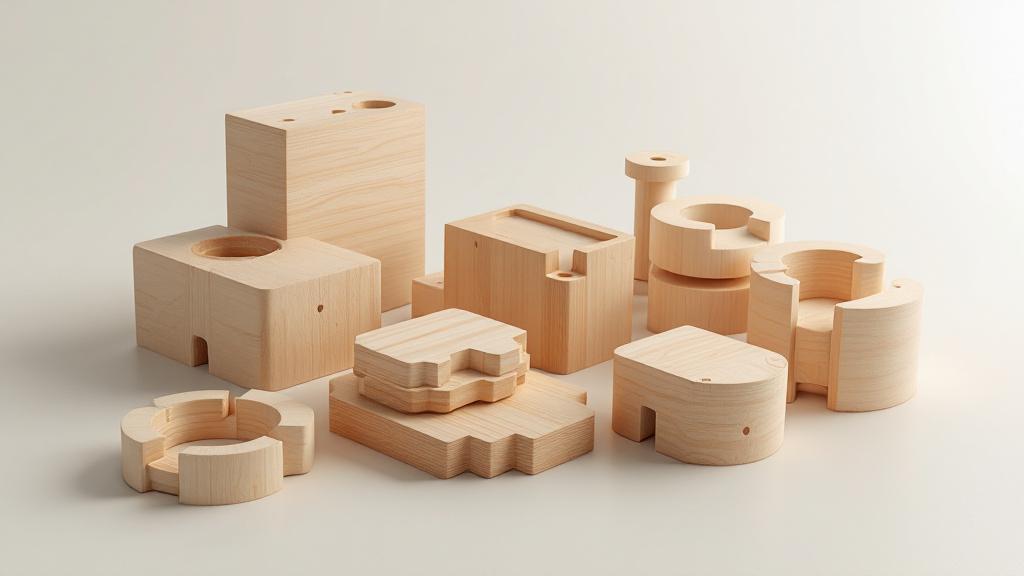
The cutter is the heart of the milling process, and the quality, cleanliness of the finish, working speed and, ultimately, the durability of the tool itself depend directly on choosing it correctly. The variety of tasks in woodworking has given rise to a huge number of cutter types, each intended for its own specific operation.
All cutters can be conditionally divided into two broad categories according to their purpose: grooving and edge.
- Grooving cutters are used to create internal elements: grooves, slots, recesses, holes and reliefs on the face of the blank.
- Straight grooving cutters are the most basic type; they create rectangular grooves, ideal for tenon joints or recesses for hardware.
- V-shaped cutters are used for engraving, creating lettering and decorative recesses with sharp corners.
- Core-box cutters form semicircular (U-shaped) grooves and are often used for decorative work.
- Joinery cutters are specific cutters for complex joints, for example for dovetails or for edge-to-edge joining.
- Edge cutters are intended for machining the outer perimeter of a part, giving the edges a decorative or functional profile. Most of them are fitted with a guide bearingwhich runs along the edge of the blank or a template, ensuring a constant depth and shape of cut.
- Straight edge cutters (flush-trim) are used to trim excess material along the contour of a template.
- Moulding cutters create rounded or shaped decorative profiles.
- Rebate cutters cut a rebate (rectangular groove) along an edge.
- Tapered cutters (chamfer) take off a chamfer at a specific angle, for example 45°.
The material of which the cutting part is made also matters. For working with soft wood species and composite materials, high-speed steel (HSS) is often used, but for hard species such as oak or ash, and to ensure durability, it is preferable to use carbide-tipped (HM) or solid carbide cutters.
Finally, the geometry of the cutting edges (straight, angled, spiral) affects the cleanliness of the cut and chip removal. Spiral cutters, for example, provide a cleaner cut and remove chips more efficiently, which is especially important in deep milling.
The right choice of cutter, based on the type of material, the required profile and the surface finish, is a key stage in the technological process. In our practice we use a wide arsenal of tools to guarantee the perfect result for every product.
Milling Different Wood Species: Features of the Work
Wood is a natural material, and every species has unique characteristics: density, hardness, grain direction, resin content. These features directly affect the choice of tool, the milling parameters and, ultimately, the quality of the resulting surface.
When working with soft species (pine, spruce, lime) there is a risk of fibre tear-out and the formation of fuzz, especially when milling across the grain. To avoid this, we use very sharp cutters and choose high spindle rotation speeds at a moderate or low feed rate. This ensures a clean, neat cut. Because of the resinous nature of softwoods, the cutters can become clogged with resin more quickly, which calls for regular cleaning of the tool.
Hardwoods (oak, ash, beech) have a high density and require greater machine power and the use of carbide cutters. When milling hardwood, the key point is the correct balance between rotation speed and feed rate. Too slow a feed can lead to overheating and scorching of the material (a “sanding” effect), while too fast a feed leads to increased load on the tool and a poorer surface finish.
Exotic and very hard species (wenge, merbau) require a special approach. Their high density and the frequent presence of interlocked grain make them difficult to machine. Here cutters with replaceable knivesare indispensable, as they ensure a constant sharpness and a more aggressive material removal.
Particular attention is paid to the direction of milling. When working with solid timber it is important always to keep the grain direction in mind. It is advisable to mill along the grain (climb milling) or at a slight angle, to minimise chipping and tear-out. When milling end grain or across the grain, the feed rate should be minimal in order to obtain a clean result.
Working with composite materials (MDF, particleboard) also has its nuances. These materials are very abrasive, which leads to rapid wear of the cutting edges. For them, specialised cutters with a diamond coating (PCD) or particularly wear-resistant carbide cutters are used.
Thus, a professional approach to milling always includes analysing the material and individually setting the processing parameters. This makes it possible not only to achieve a perfect surface but also to extend the service life of expensive equipment and tools.
Cleanliness and Surface Quality: the Fight Against Defects
The ultimate goal of milling is not only to give the part the correct shape but also to obtain a surface that meets high quality standards. The cleanliness of the surface determines how labour-intensive the subsequent sanding will be and how the finishing coat of the product will ultimately look.
Milling defects can be varied, and each of them points to one or another problem in the process.
- Fibre tear-out and chipping most often occur when working with soft or interlocked-grain wood, as well as with a blunt tool or the wrong feed direction. The solution: use sharp cutters with spiral geometry, mill in a single pass with a shallow depth, or use a “finishing” pass with minimal material removal.
- Scorching (darkening of the surface) is the result of too slow a feed rate combined with a high rotation speed, or of working with a blunt tool that begins not to cut but to rub the wood. This spoils the appearance and makes the subsequent application of lacquers or oils more difficult. The solution: increase the feed rate or sharpen the cutter.
- Waviness (kinematic) consists of microscopic irregularities on the surface, arising from machine vibration or a mismatch of cutting parameters. It is especially noticeable on wide surfaces. The solution: careful setup of the equipment, its rigidity and the use of optimal speeds.
To ensure the maximum cleanliness of the cut, a number of technological rules must be observed.:
- Tool sharpness: A blunt cutter does not cut but crushes the fibres, which leads to a poor-quality surface and an increased load on the machine. Regular sharpening or replacement of the knives is mandatory.
- Optimal cutting parameters: The balance between rotation speed (rpm) and feed rate (m/min) is critical. The aim is to ensure that each cutting tooth takes a chip of optimal thickness. Too thin a chip means scorching; too thick means tear-out and overload.
- Multi-pass machining: Deep grooves and recesses are best made in several passes, removing part of the material each time. This reduces the load, decreases vibration and improves chip removal.
- Chip removal: Effective extraction (removal of chips and dust) prevents waste from re-entering the cutting zone, which can also lead to defects and wear of the cutter.
In our work we pay particular attention to the finishing passes. Usually, after the main, rough removal of material, a finishing pass is made with minimal depth (for example, 0.5 mm). This makes it possible to eliminate the microscopic defects left by the rough cut and obtain a surface ready for minimal sanding. Quality control after milling is a mandatory procedure confirming the part’s readiness for further processing.
The Use of Milling in Furniture Production

Furniture production is perhaps the broadest sphere of application for milling technologies in woodworking. From carcass elements to decorative fronts, milling provides the precision and aesthetics needed to create high-quality furniture.
Key milling operations in furniture production:
- Making fronts: Creating frames and panels for classic and contemporary kitchen, wardrobe or cabinet fronts. Cutters with a shaped profile give the front the required style, while precise groove-cutting ensures a reliable joint in the frame.
- Machining worktops: Milling is essential for giving the edges of worktops (kitchen, office, dining) a decorative profile (for example a “bullnose”, an “antique” profile, a roundover). Milling is also used to create grooves for fixings or to integrate elements (for sink bowls, for example).
- Assembly joints: Precise milling of grooves, tenons, holes for dowels (wooden pins) and confirmats (Euro screws) ensures the correct geometry and strength of the carcasses of cabinets, chests of drawers and drawers.
- Decorative elements: The production of shaped legs for tables and chairs, decorative cornices, mouldings, overlays and grilles. CNC machines make it possible to cut complex symmetrical and asymmetrical shapes that become the accent details of the furniture.
- Making drawers: Milling is essential for creating strong dovetail or tongue-and-groove joints, as well as for cutting the grooves for the drawer bottom.
Milling makes it possible for our specialists not just to assemble parts but to create a harmonious structure. Precise edge profiling, for example on all the elements of a suite (fronts, cornices, skirting boards), ensures stylistic unity and completeness.
The use of multi-axis CNC milling centres makes it possible to carry out comprehensive machining of a part in a single set-up. For example, on the very same machine you can perform the cutting to size, cut the grooves for hardware, mill a decorative profile and carry out engraving. This significantly reduces production time and minimises the likelihood of error when repositioning the part.
In essence, milling in furniture production is the guarantor of an individual approach and high quality. It makes it possible to create both classic, complex shapes and contemporary, minimalist products, where the precision of lines and joints plays a decisive role.
Milling in the Making of Interior Elements and Architectural Details
The field of application of milling extends far beyond furniture. In the making of interior and architectural wooden elements, milling plays the role of a sculptor, making it possible to create unique, large-scale and complex decorative forms.
Such elements include:
- Doors and windows: Milling profiles for the frames and panels of door leaves, cutting grooves for glazing (rebates), as well as creating shaped architraves, cornices and extension jambs. The precision of milling here is critical to ensure the correct fit, thermal and sound insulation.
- Staircases: Making complex, shaped staircase elements — balusters, posts and handrails. Modern CNC milling machines (especially 5-axis) can turn balusters with spiral, complex profiles that were previously available only to hand carving.
- Wall panels and boiserie: Milling is used to give wall panels (boiserie) relief, to create chamfers and decorative recesses, and to produce precise jointing profiles that ensure an invisible connection between panels.
- Ceiling and wall mouldings and cornices: Using long shaped cutters, dozens of metres of moulded profiles with a repeating, complex profile are produced. This ensures the stylistic unity of the decor of an entire room.
- Decorative grilles and screens: Milling makes it possible to cut openwork, through patterns (perforations) in panels for radiator covers, decorative partitions or inserts. The precision of CNC milling ensures the fineness and strength of these openwork elements.
In architectural details, particular importance is attached to scalability and adaptation to the surroundings. Milling makes it possible not just to copy but also to modify historical or classic profiles in accordance with the dimensions and style of a contemporary project. For example, the profile of a cornice can be scaled up so that it looks harmonious in a room with high ceilings.
Work on interiors often requires machining large, massive blanks. Powerful milling equipment is able to cope with this task, providing a deep and clean cut even in dense wood.
Thus, in this field milling is a tool for the precise reproduction and artistic decoration. It makes it possible for our craftsmen to create not just individual objects but whole, stylistically complete interiors, where every wooden element harmoniously complements the others.
The Economics and Efficiency of Milling Production
In the context of modern woodworking business, milling is not only a technological but also a key economic factor. A properly organised milling section makes it possible to achieve high productivity, reduce the cost price of products and increase their competitiveness.
The main economic effect is achieved through automation and high processing speed. CNC machines work continuously, with minimal operator involvement, which significantly reduces labour costs compared with manual or semi-automatic processing.
Reducing material waste is a critically important aspect. The software used in CNC milling (nesting systems) makes it possible to place parts of various shapes on the blank as densely as possible (cutting optimisation). This minimises the amount of offcuts and, accordingly, reduces raw-material costs.
Reducing the likelihood of rejects also has a direct effect on the economics. The high precision of CNC equipment practically rules out errors caused by the human factor. The fewer rejects, the less rework and the less loss of expensive material.
Production flexibility makes it possible to switch quickly and without great expense between small individual orders and large batches. The ability to change the machining program quickly makes it possible to respond effectively to market demand without resorting to costly retooling of the equipment.
Summing up the economic advantages:
- High productivity: Automation and cutting speed.
- Material optimisation: Efficient cutting layout (nesting) and a low percentage of rejects.
- Reduced labour intensity: Minimal manual intervention, especially in serial production.
However, high efficiency requires significant investment in equipment and personnel. Modern milling centres are expensive machines that require skilled servicing and professional programming. Our specialists are constantly improving their qualifications in order to make the most of this equipment’s potential.
Ultimately, milling is not merely a way of machining wood but an investment in quality and efficiency. It allows our company to maintain high product standards, offering clients products with flawless geometry and complex, unique decor, while keeping a competitive price.
Milling in the Creation of Unique Decor: 3D Carving and Engraving
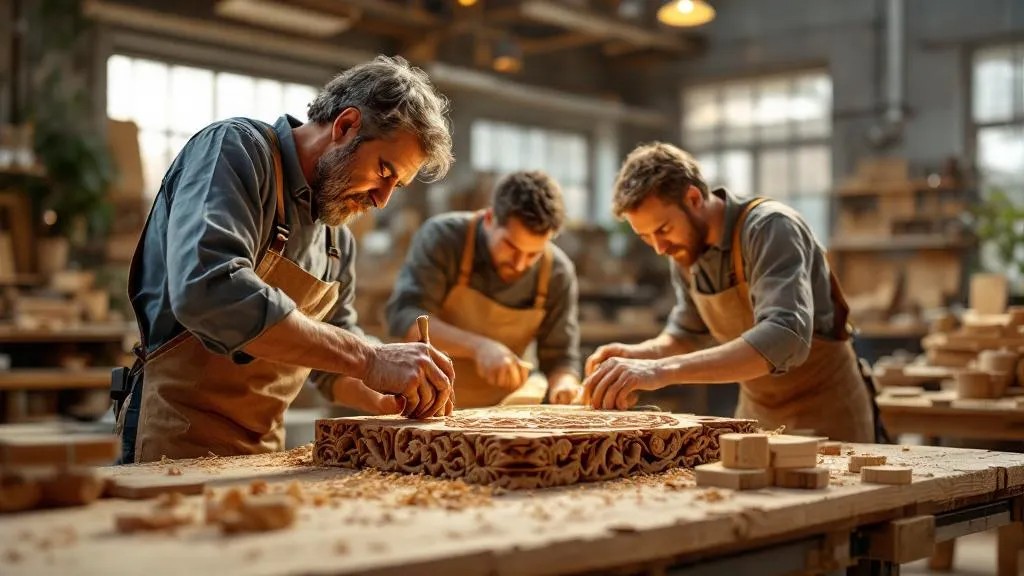
Three-dimensional milling, or 3D carving, is the pinnacle of technological and artistic mastery in woodworking, made possible by the development of multi-axis CNC milling machines. This method makes it possible to go beyond flat processing, creating truly unique and complex decorative elements.
3D carving means that the cutter moves along all three axes (X, Y, Z) simultaneously, forming a three-dimensional relief on the surface or carving a figure out of a solid block of material.
Applications of 3D milling:
- Artistic panels and bas-reliefs: Creating three-dimensional pictures that imitate hand carving, with a high level of detail. These can be heraldic symbols, portraits, scenes from life, floral or geometric ornaments.
- Complex shaped elements: Making decorative furniture elements (for example carved overlays, shaped brackets, capitals) that have a complex, curved profile in several planes.
- Modelling and prototyping: Milling makes it possible to create precise wooden models for casting moulds or prototypes of complex parts before their serial production.
The process of 3D milling begins with digital modelling. A designer-artist creates a model in special software (CAD), and then a process engineer develops a multi-stage machining program. As a rule, the work consists of several stages:
- Rough pass: Rapid removal of the bulk of the material with a large cutter.
- Semi-finishing pass: More detailed processing to approach the final shape.
- Finishing pass: A slow and precise pass with small, often ball-nose or tapered, cutters to obtain a smooth, detailed surface.
Engraving using V-shaped cutters is a simpler but no less striking technique. It is used to apply lettering, logos, fine lines and ornaments to flat surfaces, for example on plaques, signs or fronts.
Particular attention in 3D milling is paid to the choice of stepover (the distance between tool passes) and the cutter tilt angle . The smaller the stepover, the cleaner and more detailed the surface will be, but the longer the processing will take. The balance between quality and time is a key point in optimising the process.
Thus, 3D milling is our opportunity to embody in wood the boldest design ideas. It combines the traditional beauty of carved wood with the flawless precision of modern technology, creating truly exclusive products.
The Miller’s Toolkit: from Hand to Stationary Equipment
To achieve high milling quality in professional woodworking, a whole arsenal of equipment is used, which is divided into hand tools, stationary machines and high-tech machining centres.
- Hand router (trimmer): This is a mobile and versatile tool, indispensable for on-site work or for machining the edges of small parts. It is used for taking off chamfers, rounding over edges, cutting shallow grooves and template routing. In production it often complements large equipment, performing finishing, minor operations.
- Stationary vertical spindle moulder: A classic machine with a worktable through which a vertically positioned spindle passes. It is used for edge profiling and for making grooves and tenons with insert cutters. This machine requires a highly skilled operator but makes it possible to machine large and long parts, such as door frames and moulded profiles.
- Copy-milling machines: Used for the serial production of identical parts of complex shape. The operator moves a copying finger along a template, and the cutter synchronously reproduces this path on the blank. This was the transitional link between manual work and CNC.
- CNC milling machining centres (3-, 4-, 5-axis): This is the modern heart of any large woodworking production.
- 3-axis machines work in a plane and are ideal for cutting to size, flat engraving and cutting grooves.
- 4-axis machines add the ability to rotate the blank (the A axis), which makes it possible to turn bodies of revolution — balusters, legs of complex profile.
- 5-axis machines are able to rotate not only the blank but also the spindle itself, which makes it possible to machine the most complex three-dimensional surfaces inaccessible to other types of equipment.
The choice between hand and stationary equipment always depends on the volume and nature of the work. For one-off, unique parts and work on site, a hand router is indispensable. For serial production, high precision and complex shapes — only CNC machines.
Our production is equipped with modern CNC centres, which allows us to guarantee consistently high quality and speed of fulfilment of orders of any complexity.
Protection and Safety: the Necessary Conditions for Milling
Milling, like any high-speed machining of wood, requires strict observance of safety rules and the use of protective equipment. A cutter rotating at high speed poses a potential danger that must be fully controlled.
Operator safety
Protecting the operator is a priority. On modern CNC equipment the cutting zone is, as a rule, fully enclosed by a protective housing that prevents the ejection of chips and dust and rules out access to the tool during operation. When working on stationary and hand routers, the following are mandatory:
- The use of personal protective equipment (PPE): Safety glasses or a face shield, ear defenders (because of the high noise level), as well as close-fitting work clothing without loose elements that could be caught by the rotating tool.
- The use of hold-downs and feed devices: Holding the workpiece by hand when working on a stationary router is categorically forbidden. Reliable mechanical or pneumatic hold-downs, as well as power feeders, must be used.
- Correct setup: You must not switch on the machine before the cutter is securely fastened and all the guards and guides are in place.
Protecting the equipment and the workplace
Woodworking equipment needs protection no less than people do. The main problem is wood dust and chips.
- Extraction systems: An effective dust-extraction (aspiration) system must be connected to every milling machine. Dust and chips are not only harmful to health but also settle on the moving parts of the machine, accelerating their wear and affecting precision.
- Cooling and lubrication: For high-speed spindles, proper cooling (air or liquid) is important. Lubrication of the guides and moving assemblies ensures smooth running and durability.
- Tool balance control: An unbalanced cutter causes strong vibration, which not only impairs the machining quality but also destroys the spindle bearings. All large cutters must be professionally balanced.
In our company we attach great importance to a culture of safe work. Strict adherence to process sheets, regular briefings and the use of only serviceable equipment with connected protective systems — this is not merely a requirement, it is a necessary condition for the output of quality products and the preservation of our employees’ health.
Finishing Work After Milling: Sanding and Finish

Milling gives a part its precise shape and profile, but even the cleanest milling does not remove the need for subsequent finishing operations, the main of which is sanding. The quality of the sanding determines how the finishing coat — lacquer, oil or paint — will look.
Sanding after milling should ideally be minimal. If the milling has been done well, with optimal parameters, then only insignificant tool marks (microscopic “tracks”) or a small amount of fuzz remain on the surface.
Stages of sanding
- Removing fuzz: At the first stage, abrasives with a relatively coarse grit (for example P100-P120) are used to remove any milling marks and raised fuzz.
- Intermediate sanding: After the first pass the grit is increased (P180-P220). The aim is to eliminate the marks left by the previous abrasive and prepare the surface for applying the first coat of finish.
- Sanding profiled edges: Shaped profiles created by edge cutters often require hand or machine sanding using special sponges or profiled blocks in order to preserve the crispness and geometry of the profile.
- Intermediate sanding after priming/the first coat: After applying the first coat of finish (primer or lacquer), residual fuzz rises. This coat is sanded with a very fine abrasive (P320-P400) to ensure perfect smoothness and better adhesion for the subsequent coats.
The Role of Milling in Finishing
Milling affects the finish in two main ways:
- Cleanliness of the cut: The cleaner the milling cut, the less time and resources are spent on sanding, which reduces the overall cost price of the product.
- Preparation for the coating: Milling can create special surfaces. For example, for applying thick layers of paint (enamel) or a complex patina, the cleanliness of the surface can be slightly lower than for a clear high-gloss lacquer, where any irregularity is visible.
After sanding, the part is ready for the finishing coat. This can be:
- A clear finish: Lacquers and oils that emphasise the natural texture of the wood.
- An opaque finish: Paints and enamels that create a uniform colour.
The use of modern milling technologies in our work makes it possible for us to obtain surfaces that require minimal intervention at the sanding stage. This guarantees the preservation of the crispness of all the geometric elements and profiles created by the cutter and, consequently, a flawless appearance of the finished product.
Prospects for Development: Innovations in the Milling of Wood
Technology does not stand still, and the milling of wood continues to develop, offering new possibilities for improving the quality, speed and environmental friendliness of production. The future of milling is linked to a deeper integration of digital technologies and the improvement of tooling.
Key areas of innovation:
- Adaptive milling (Smart Machining): This is the integration of sensors into the machine (or even into the cutter) that monitor the load on the spindle, vibration and temperature in real time. The system automatically corrects the feed rate and rotation speed, optimising the cutting parameters to the irregularities of the wood. This minimises rejects, extends the tool’s service life and guarantees a perfect surface finish.
- The use of new materials for the tool: The development of cutters with even more wear-resistant coatings (for example, with a modified diamond coating) and improved geometry. New spiral cutters with a variable pitch, for example, reduce noise and vibration, making the process more comfortable and precise.
- Robotisation and collaborative robots (cobots): The introduction of industrial robots fitted with milling heads to perform 3D milling of large and complex objects, such as sculptures or complex architectural elements. Cobots can work alongside a human, performing routine, high-precision operations.
- Integration with 3D scanning: The use of 3D scanners to rapidly obtain a digital model of an existing part (for example, in the restoration or copying of antiques). The scanner transmits the data to the CNC system, which generates a program for the precise reproduction of the part.
- Environmentally friendly and quiet solutions: The development of cutters with an optimised design to reduce aerodynamic noise, as well as the improvement of extraction systems for the maximum removal of dust and reduction of harm to the environment.
Our specialists follow these trends closely. The introduction of 5-axis machining technology has already allowed us to master the production of elements that until recently were considered exclusively hand labour. We see the future of milling as a process that will become even more intelligent, precise and efficient, allowing us to create wooden products that combine traditional aesthetics with flawless technological execution.
Conclusion
Milling is not merely a mechanical operation; it is the cornerstone of modern woodworking production, which determines the functionality and aesthetics of the finished wooden product. From the strength of a mortise-and-tenon joint to the fineness of a 3D ornament on a front — milling is the guarantor of precision, quality and design freedom.
The use of modern CNC machines, the variety of specialised tools and a deep understanding of the features of each wood species allow us to turn simple blanks into durable, beautiful and high-quality products, be it furniture, interior elements or architectural details. Milling remains the key process thanks to which a traditional material such as wood fully meets the high demands of modern production and design.
The main advantages of professional milling:
- High precision: Perfect geometry and repeatability, critical for assembly.
- Unlimited design: The ability to create complex 3D reliefs and shaped profiles.
- Functionality: The precise creation of joints (grooves, tenons) and seatings for hardware.
- Cost-effectiveness: Optimisation of material consumption and reduction of rejects with the help of CNC.
We are always ready to advise you on milling matters and to bring to life your most complex projects that require the perfect machining of wood.





