
Technologies for sawing wooden boards: features and types of equipment
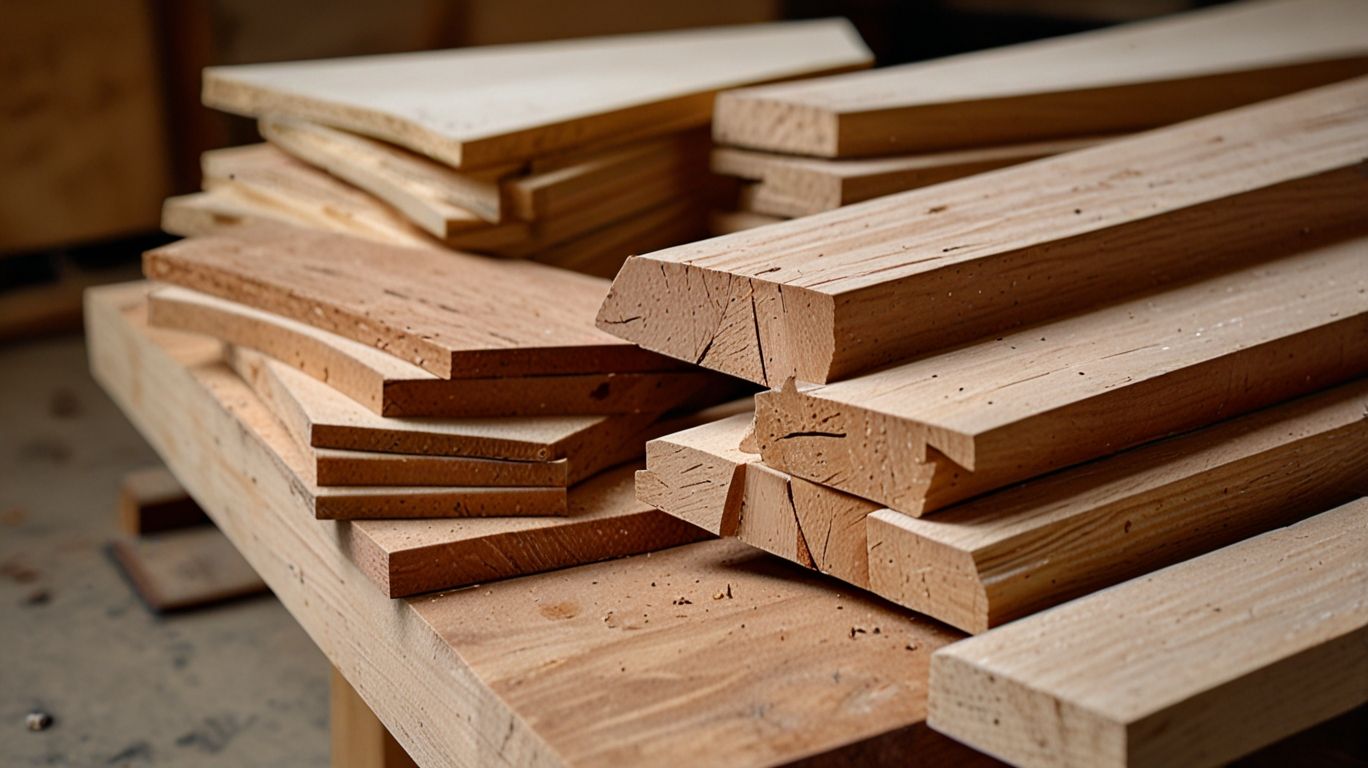
Working with wood begins long before the craftsman picks up a chisel or assembles furniture. The first and perhaps most important stage is sawing the log into boards. How this process is organised determines not only the yield of finished material but also its quality — and therefore the end product. There are no trifles here: every sawing technology and every type of equipment has its own features that affect the structure of the wood, its strength, and even the appearance of the future product.
Why are there so many sawing options?
At first glance it may seem that sawing is simple: you take a log and cut it into pieces. But in reality it’s a whole science. Wood is a non-uniform material with its own unique structure. Inside the trunk, the fibres run in different directions; there is the pith, the annual rings, the knots. All of this has to be taken into account in order to obtain material with the required properties.
Imagine you need a board for a worktop that will last for decades without deforming and while keeping its looks. Or a beam for a load-bearing structure that has to withstand colossal loads. Each such task calls for its own type of sawing. The right choice of technology makes it possible to minimise waste, improve the quality of the finished timber, and reduce the cost of its subsequent processing.
The wrong approach to sawing can lead to boards warping, cracks appearing, and strength being reduced. This directly affects the durability and reliability of the end products. That is why a deep understanding of all the subtleties of sawing is the foundation of successful wooden-product manufacturing.
Types of sawing: when every line matters
There are several main types of sawing, each of which dictates a particular orientation of the cutting edge relative to the wood fibres. These are not just different ways of cutting a log but approaches that shape the unique characteristics of each board.
Quarter (radial) sawing (Rr)
In quarter sawing, the plane of the cut passes through the pith of the log, perpendicular to the annual rings. Imagine cutting a pie from the centre to the edge. Boards obtained this way have their own recognisable features.
Features:
- Wood pattern: On the surface of a quarter-sawn board, the annual rings appear as parallel lines, showing almost none of the “figure” characteristic of flat sawing. This gives the board a more uniform, calm look.
- Stability: This is perhaps the main advantage. Quarter-sawn boards are less prone to shrinking and swelling. They barely deform with changes in humidity and temperature. This is because the wood fibres run as straight as possible relative to the plane of the board. Their coefficient of shrinkage and swelling is lower than that of flat-sawn boards.
- Strength: Thanks to the orientation of the fibres, such boards have high strength and wear resistance. They resist abrasion better and are less prone to cracking.
- Application: Ideal for making parquet, flooring, high-quality furniture, window frames, doors, and parts of musical instruments, where maximum stability and durability are required. Wherever geometry and resistance to external influences are critical, quarter sawing is the optimal choice.
- Material yield: The main drawback is the low timber yield. Relatively few quarter-sawn boards can be obtained from a single log, which makes them more expensive. This is because obtaining such boards requires cutting away large volumes of wood, which then goes to waste or into the production of lower-value timber.
Flat (tangential) sawing (Tg)
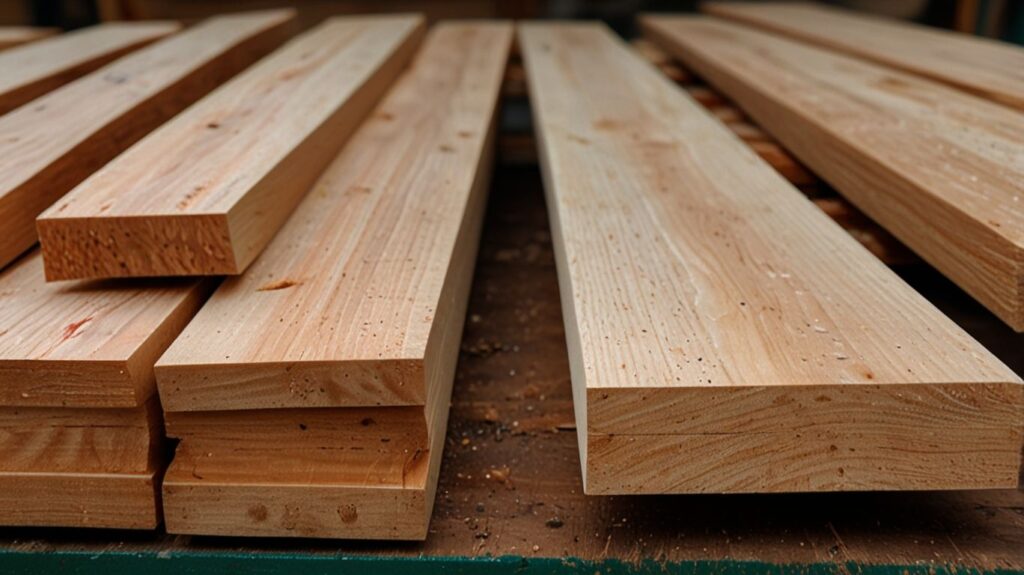
Flat sawing is when the plane of the cut passes at a distance from the pith, tangent to the annual rings. To continue the pie analogy, it’s as if you cut a slice not from the centre but closer to the edge.
Features:
- Wood pattern: Flat-sawn boards are famous for their vivid, expressive pattern, known as a “flame” or “cathedral” figure. This is because the annual rings are clearly visible on the surface of the board in the form of cone-shaped or arched patterns.
- Stability: Unlike quarter sawing, flat-sawn boards are more prone to deformation — shrinking, swelling, warping. With changes in humidity they can change their size and shape. This is because in this case the wood fibres cross the plane of the cut at a significant angle, which leads to uneven changes in dimensions across the width of the board.
- Strength: In terms of strength they are inferior to quarter-sawn boards, especially in resistance to bending and splitting.
- Application: Widely used for the production of furniture, cladding panels, joinery, and decorative elements, where appearance matters and requirements for stability and wear resistance are less critical. Thanks to its economy and aesthetic appeal, flat sawing is one of the most common.
- Material yield: A significantly higher timber yield from the log, which makes it more economical and affordable. This is a key factor for large-scale production.
Mixed sawing (rift, rustic)
This is an intermediate option that combines the features of quarter and flat sawing. The plane of the cut passes at an angle to the annual rings but not through the pith.
Features:
- Wood pattern: On the surface of such boards you can see both straight lines and partial arcs, which creates an interesting, unique pattern.
- Stability: In terms of stability they occupy an intermediate position between quarter and flat sawing. They are less prone to deformation than flat-sawn boards but inferior to quarter-sawn ones.
- Strength: They have good strength, suitable for most joinery and construction needs.
- Application: Used where extreme stability is not required but good performance characteristics and aesthetics matter. These can be furniture elements, wall panels, and some types of flooring.
- Material yield: An optimal timber yield, which makes them an economically advantageous compromise between the two main types of sawing.
The choice of sawing type is dictated by the specific requirements for the end product. For parquet that has to last for decades, quarter sawing is preferable. For a furniture front, where the pattern matters, flat sawing is often chosen.

Log-sawing technologies: from raw material to board
In addition to the types of sawing, there are various technologies that determine the scheme for breaking down a log into timber. These are not just methods of cutting but whole strategies that take into account the geometry of the log, its species, the presence of defects, and, of course, the requirements for the finished product. Each technology has its advantages and disadvantages, affecting the volume of timber yield, its quality, and labour input.
Through-and-through (plain) sawing
This is one of the most common and economical methods of sawing. Its essence is the successive cutting of boards from the log without turning it. The log is fixed on the bed and sawn layer by layer.
Features:
- Principle: The log is fed onto the sawmill and layers of wood are removed from it. Boards obtained this way have varying widths and, as a rule, will be of the flat or mixed type, apart from a few central boards that may be closer to quarter-sawn.
- Advantages:
- Simplicity: This is a relatively simple method that doesn’t require complex equipment or high operator qualifications.
- High productivity: Sawing is fast, as there is no need for frequent turning of the log.
- Minimal waste: It makes it possible to make maximum use of the log’s volume, as waste is minimised by producing boards of varying widths.
- Economy: Low sawing costs make this method attractive for mass production.
- Disadvantages:
- Non-uniform output: The main drawback is obtaining boards of different sizes and with different patterns (mostly flat or mixed). This can be a problem if a strictly defined type of sawing or standardised dimensions are required.
- Risk of warping: Boards, especially those obtained from the outer layers, are more prone to warping and deformation due to the predominantly flat sawing.
- Application: Widely used to obtain edged and unedged boards for general purposes, beams, cants, and also for the production of pallet boards, building materials, and elements of rough structures. Ideal for the primary sawing of logs when strict requirements for material uniformity are not imposed.
Cant sawing (with cant production)
This technology involves dividing the log into a central cant and two or four side boards (slabs). This cant can then be sawn further into boards or used as a finished cant.
Features:
- Principle: First, two or four slabs are cut from the log, forming a cant of square or rectangular section in the centre. This cant can then be sawn further into boards of the required thickness or used as a finished cant.
- Advantages:
- Cant production: It makes it possible to obtain a cant straight away, which is a sought-after timber product in construction.
- Rational use: The side boards (slabs) can also be used, which increases the overall efficiency of the sawing.
- High productivity: A fast method of sawing, especially when using twin-shaft or multi-saw machines.
- Reduced waste: Waste is minimised through the comprehensive use of the log.
- Disadvantages:
- Variety of timber: As with through-and-through sawing, here you can obtain boards with different types of sawing — from flat to quarter — depending on their location in the cant.
- Warping potential: The side boards may be more prone to warping.
- Application: Ideal for the production of cants for building houses, saunas, and gazebos, as well as for obtaining edged boards of various sizes. Widely used at sawmilling enterprises where there is demand for cants and boards.

Grade sawing (with turning, segmented sawing)
This technology is more complex and labour-intensive but makes it possible to obtain timber with specified characteristics, in particular quarter-sawn boards. The log is turned 90 degrees after each pass of the saw or group of saws.
Features:
- Principle: After each cut, the log is turned 90 degrees (or another specified angle) so that the next plane of the cut passes at the required angle to the annual rings. This makes it possible to control the orientation of the fibres to the maximum.
- Advantages:
- High board quality: It makes it possible to obtain boards with predominantly quarter or mixed sawing, which have high stability, strength, and wear resistance.
- Minimised deformation: Boards obtained this way are less prone to warping and cracking.
- Valuable timber: It makes it possible to obtain the most valuable and expensive types of timber.
- Disadvantages:
- Low productivity: It requires more time for sawing because of the need to turn the log and readjust the equipment.
- High labour input: The process is more labour-intensive and requires a more qualified operator.
- High waste: Obtaining purely quarter-sawn boards can generate a significant amount of waste.
- Application: Used for the production of high-quality timber for parquet, premium furniture, doors, windows, musical instruments, and other products where stability and appearance are of decisive importance.
Quarter sawing (radial from the centre)
This is a specialised method aimed at obtaining the maximum number of quarter-sawn boards.
Features:
- Principle: The log is first sawn into four parts (quarters) along mutually perpendicular planes passing through the pith. Each quarter is then sawn into quarter-sawn boards.
- Advantages:
- Maximum quarter-sawn yield: This technology provides the highest percentage of quarter-sawn boards.
- High quality: The resulting material has all the advantages of quarter sawing: stability, strength, durability.
- Disadvantages:
- Very low productivity: The process is very slow and labour-intensive.
- High waste: A significant amount of waste, which makes this method one of the most expensive.
- High cost: Because of all the factors listed above, timber obtained this way is very expensive.
- Application: Used in very narrow niches where an exceptionally stable and high-quality material is required — for example, for the production of soundboards for musical instruments and parts for high-precision joinery.
The choice of sawing technology is always a compromise between the desired product quality, the volume of timber yield, and the economic indicators of production. Experienced enterprises always select the optimal method based on the type of wood, the customer’s requirements, and their production capacity.
Sawing equipment: the tools for transforming a log
Now that we’ve dealt with the types of sawing and the technologies, let’s look at which machines help transform a log into a finished board. Modern sawmilling is a complex set of equipment where each machine performs its own function, ensuring the accuracy, speed, and quality of the cut.
Band sawmills
Band sawmills are perhaps some of the most common and versatile machines for sawing wood. Their distinctive feature is the use of a thin steel band saw stretched between two wheels.
Features:
- Operating principle: The log is placed on the bed, and the saw band, moving in a loop, cuts through the wood. The saw carriage can move horizontally (mobile band sawmills), or the log can move relative to a fixed saw frame (stationary band sawmills).
- Advantages:
- Thin kerf: The main advantage of band sawmills is a very thin kerf (usually 1.5–3 mm). This significantly reduces the loss of wood to sawdust, which is especially important when working with valuable species.
- High timber yield: Thanks to the thin kerf, the yield of finished boards increases by 10–20% compared with circular sawmills.
- Flexibility: They make it possible to saw logs of various diameters and lengths, as well as to obtain boards of different sizes and sawing types.
- Mobility: There are mobile versions that can be moved directly to the site of the timber harvest.
- Surface quality: The sawn surface often comes out fairly smooth, which reduces the cost of subsequent processing.
- Disadvantages:
- Sensitivity to metal: Band saws are very sensitive to foreign inclusions (nails, shell fragments), which can cause them to break.
- The need for regular sharpening: The bands require frequent and high-quality sharpening, as well as tooth setting, which adds to the labour input and requires special equipment.
- Limited feed speed: The sawing speed on band sawmills is lower than on circular ones, especially with large volumes.
- Vibration: Vibrations can occur during operation, which affect the accuracy of the cut.
- Application: Ideal for small and medium-sized production, for sawing valuable wood species, and for mobile sawmilling complexes.
Circular sawmills
Circular sawmills use round saw blades to saw the log. These are powerful, high-output machines capable of handling large volumes of wood.
Features:
- Operating principle: The log is fed on a carriage, and one or more circular saws, arranged horizontally or vertically, cut it to the specified thickness.
- Advantages:
- High productivity: Circular sawmills are distinguished by a high sawing speed, which makes them indispensable for large-scale production.
- Cutting accuracy: They ensure high accuracy and repeatability of board dimensions.
- Resistance to foreign inclusions: They are more resistant to accidental metal inclusions in the wood than band saws.
- Durability of the saws: The saw blades are more durable and require less frequent sharpening.
- Multi-saw capability: Some models allow several blades to be installed at once, which significantly speeds up the process.
- Disadvantages:
- Wide kerf: The main drawback is a wider kerf (3–7 mm) compared with band sawmills, which leads to greater loss of wood to sawdust.
- High cost: The machines themselves and the saw blades cost more.
- Lower flexibility: Less flexible in terms of changing board thickness during sawing.
- Application: Widely used at large sawmilling complexes, in woodworking shops with high production volumes, and for sawing softwood and soft hardwood species.

Cant sawing machines
Cant sawing machines are specialised equipment designed for the primary sawing of a log into a cant (two-sided or four-sided) and side boards.
Features:
- Operating principle: The log is fed through a system of rollers, and two or four saws (circular or milling) cut it simultaneously, forming the cant.
- Advantages:
- High productivity: A very high sawing speed, as the main volume of timber is formed in a single pass.
- Accuracy: They ensure high accuracy of the cant’s geometry.
- Automation: Many models are fully automated, which reduces the need for manual labour.
- Economy: They use raw material efficiently, minimising waste in the production of cants.
- Disadvantages:
- Specialisation: Designed mainly for producing cants; less versatile for the production of other types of timber.
- Large investment: The high cost of the equipment itself.
- Application: Indispensable at large sawmilling enterprises oriented towards the production of structural cants, glued laminated timber, and other large-format timber products.
Multi-rip saws
Multi-rip saws (gang rip saws) are the next stage after cant sawing machines or band/circular sawmills. They are designed for the lengthwise sawing of an already-obtained cant or wide boards into narrower blanks (edged boards, battens).
Features:
- Operating principle: The workpiece (a cant or a wide board) is fed into the machine, where it is cut simultaneously by several saw blades mounted on one or two shafts. The distance between the blades is adjustable, which makes it possible to obtain blanks of the required width.
- Advantages:
- Maximum productivity: The main advantage is a phenomenal sawing speed. In a single pass you can obtain several finished boards or battens at once.
- Accuracy: High accuracy of the dimensions and geometry of all the resulting blanks.
- Time saving: They significantly reduce the time for sawing large volumes of wood.
- Automation: They are often integrated into automated lines.
- Disadvantages:
- Specialisation: Designed for secondary sawing; they cannot work with logs.
- Requirements for the workpiece: They require the fed workpiece to be already calibrated (straight, without major defects).
- High cost: As a rule, this is expensive equipment.
- Application: Used at all stages of woodworking production where the fast and accurate production of edged boards, battens, lamellae for glued laminated timber, and blanks for furniture and other joinery is required.
Edging machines
Edging machines are designed to give a board the correct geometric shape by trimming the unedged sides (the wane).
Features:
- Operating principle: An unedged board is fed into the machine, where two movable or fixed saws trim its edges, forming straight sides. In some models the saws can be adjusted for width to obtain a board of the optimal size.
- Advantages:
- Standardisation of dimensions: They make it possible to obtain an edged board with standardised widths.
- Improved quality: Removing the wane increases the grade of the timber and improves its appearance.
- Reduced waste: They optimise the use of wood, as they make it possible to remove only the excess.
- Disadvantages:
- An additional stage: It is an additional stage in the production cycle.
- Losses in offcuts: They generate an additional volume of waste in the form of edge trimmings.
- Application: Indispensable at any sawmilling production where high-quality edged timber is required.
Combined and specialised machines
In addition to the main types, there are also combined machines that combine the functions of several machines (for example, cant-and-edging complexes), as well as specialised equipment for sawing large-diameter logs, for producing thin lamellae, and so on.
Choosing equipment for a sawmill is a serious investment decision. It depends on the planned production volumes, the types of wood being sawn, the required product range, and, of course, the budget. A correctly selected set of equipment makes it possible to optimise production processes, reduce the cost of production, and ensure its high quality.
The importance of accuracy and cutting quality
Regardless of the chosen technology and equipment, the accuracy and quality of the cut play a key role. These are not just words — they are the foundation for all subsequent work with the wood.
Geometry and tolerances
The first thing people pay attention to when assessing cut quality is the geometry of the board. It must be even, without waviness or variations in thickness and width. Tolerances for deviations are strictly regulated by state standards (GOST) and industry norms. For example, for an edged board 25 mm thick, a deviation in thickness of no more than 1–2 mm and in width of 2–3 mm is permitted, depending on the grade. Adhering to these tolerances is critical, since a bent or uneven board is not only harder to process further but can also become a source of defects in the end product.
When we speak of accuracy, we mean not only evenness but also strict conformity to the specified dimensions. If a board is supposed to be 50 mm thick, it should be exactly that, not 48 or 52 mm. Deviations lead to excessive use of material during jointing or planing, as well as to problems during the assembly of products.
Surface quality
The second important aspect is the surface quality of the cut. It must be as smooth as possible, without tear-out, fuzziness, burn marks, or other defects that arise from an incorrectly sharpened saw, worn equipment, or the wrong feed speed. A clean cut reduces the time and resources needed for subsequent processing — planing, sanding. If the surface is uneven, a thicker layer of wood will have to be removed, which increases waste and reduces the usable volume of the board.
Impact on subsequent stages
The quality of the cut directly affects all subsequent stages of woodworking:
- Drying: Boards with inaccurate geometry dry unevenly. This can lead to internal stresses, cracking, and warping as early as the drying stage.
- Planing and calibration: If boards are sawn inaccurately, they will be harder and more expensive to plane. It will take more passes of the machine, more effort, and more loss of material. Bent boards may simply not pass through the calibration machines.
- Gluing: For gluing panels or beams, accurate geometry is critical. Uneven edges lead to a poor glue joint that will be weak and unsightly.
- Manufacturing products: Ultimately, all these problems show up in the finished product. Furniture, windows, doors, and floors made from poorly sawn material will have defects, a worse appearance, and, most importantly, a shorter service life.
Quality control
That is why the quality control of sawing must be constant. This includes the regular checking of board geometry, the condition of the cutting tool, and the calibration of the equipment. Investments in quality equipment and trained staff pay off through reduced rejects, an increased yield of usable material, and the production of goods that meet the highest standards.

Features of sawing different wood species
You can’t approach the sawing of different wood species in the same way. Each tree has its own character, its own hardness, its own density, and its own fibre features. What suits pine may be absolutely unacceptable for oak or beech. Experienced craftsmen always take these nuances into account.
Softwood species (pine, spruce, larch, fir)
These are the most common species in woodworking, thanks to their availability, relatively low cost, and ease of processing.
- Features:
- Softness: Softwood species are fairly soft, which makes sawing easier.
- Resin content: They contain resin, which can stick to the saw, especially at high temperatures.
- Knots: They often have knots, which can be harder than the main wood.
- Sawing nuances:
- Feed speed: You can use a high feed speed, especially on circular sawmills.
- Saw sharpening: The saws must be well sharpened to avoid resin build-up and burning. It’s recommended to use saws with a special coating that reduces friction.
- Cooling: It’s important to ensure good cooling of the saw to prevent overheating and resin build-up. Special lubricating fluids or solutions are sometimes used to help reduce resin sticking.
- Type of saw: Both band and circular sawmills are suitable for softwood species. Circular ones are often used for mass production thanks to their productivity.
Hard hardwood species (oak, beech, ash, maple, hornbeam)
These species are valued for their strength, durability, and beautiful texture. But they are also harder to work with.
- Features:
- Hardness: Significantly harder than softwood species, which requires more effort and more powerful equipment for sawing.
- Density: High density also affects the process.
- Fibres: The fibres can be more tangled, which increases the risk of chipping.
- Sawing nuances:
- Feed speed: A lower feed speed is required to avoid overloading the saw and the equipment.
- Saw sharpening: Sharp saw sharpening is critically important. A dull saw not only produces a poor-quality cut but also wears out quickly and can lead to overheating of the wood and the equipment. For hard species, saws with carbide tips are often used.
- Type of saw: Band sawmills are often preferable for hard species, since their thin kerf makes it possible to reduce the load on the saw and cut down on the consumption of valuable wood. Circular sawmills are also used, but they require more powerful motors and special saws.
- Cooling: Good cooling of the saw is essential.
- Drying: The sawing of hard species is often preceded by a long and complex drying process, which also requires special attention.
Soft hardwood species (linden, aspen, alder, birch)
These species occupy an intermediate position between softwood and hard hardwood.
- Features:
- Medium hardness: Relatively soft, easy to work with.
- Uniformity: They often have a more uniform structure without large knots.
- Sawing nuances:
- Feed speed: You can use a medium to high feed speed.
- Saw sharpening: Regular sharpening is required, but not as frequent as for hard species.
- Type of saw: Both types of sawmill are suitable — band and circular. The choice depends on the volumes and the quality requirements.
- Moisture: Some soft hardwood species (birch, for example) may be prone to changing colour if stored or dried incorrectly after sawing.
Exotic and especially hard species (wenge, merbau, iroko)
Working with such species requires a special approach and specialised equipment.
- Features:
- Extreme hardness: They can be very hard and dense, which puts an enormous load on the cutting tool.
- High resin/oil content: Some species contain a lot of oils or abrasive inclusions that quickly blunt the saws.
- Sawing nuances:
- Special saws: Saws with reinforced carbide tips or even diamond coating are required.
- Low feed speed: A very low feed speed, so as not to overload the saw and the equipment.
- Intensive cooling: Maximum cooling of the saw.
- Equipment wear: These species heavily wear out not only the saws but also other parts of the machine — the bearings, the guides.
Taking the specifics of the wood species into account during sawing is the key to obtaining quality timber with minimal losses. This is not just a technical matter but a deep understanding of the material you’re working with.
The effect of wood moisture on sawing
Wood moisture is one of the most important factors that directly affects the entire sawing process, the quality of the resulting timber, and equipment wear. This is not a secondary nuance but a fundamental condition for efficient work.
Why is moisture so important?
Imagine trying to cut a fresh, juicy cucumber and a dry rusk. Obviously, the process will be different. It’s the same with wood, only the scale and consequences are different.
- Cutting resistance: The higher the moisture content of the wood, the lower its resistance to cutting. Green wood cuts more easily than dry wood. This may seem like a plus, but it has its pitfalls.
- Sawdust build-up: Green wood contains a lot of moisture and sap, which mix with the sawdust during cutting and form a viscous mass. This mass sticks to the saw, clogs the teeth, impairs chip removal, and increases friction.
- Saw overheating: The increased friction heats up the saw. If moisture sticks to it, cooling of the saw deteriorates and it can overheat. Overheating leads to a change in the structure of the saw metal, a loss of its hardness, deformation, and rapid failure.
- Surface quality: The build-up of resin and sawdust, as well as saw overheating, inevitably affect cut quality. The surface of the board can be fuzzy, burnt, with lumps stuck to it. This worsens the appearance and requires additional processing.
- Cutting accuracy: An overheated saw can “wander”, drifting to one side, which leads to inaccurate board geometry. In addition, uneven stress in green wood can cause the board to deform immediately after sawing.
- Equipment wear: The increased friction and load caused by wet wood increase the wear of saws, bearings, and other moving parts of the machine.
Optimal moisture for sawing
Ideal for sawing is wood that is in a state between absolutely dry and absolutely green — so-called shipping moisture or moderately green wood. This is usually a range from 30% to 60%. In this state the wood is soft enough for efficient cutting but doesn’t release excess moisture that would stick heavily to the saw.
- Freshly cut wood (moisture above 60–80%): Sawing such wood causes maximum build-up, rapid saw wear, and strong heating.
- Air-dry wood (moisture 18–22%): Sawing such wood requires more power from the machine and sharper saws, but gives a very clean cut and minimal build-up problems.
- Kiln-dry wood (moisture 8–12%): Sawing very dry wood (after kiln drying) can be difficult, especially for hard species. Saws blunt quickly and there is a risk of chipping.
How to account for moisture during sawing?
- Choice of saw: For sawing green wood, saws with a greater tooth set and more aggressive geometry are often used to remove sawdust better. Special coatings on the saws also help reduce build-up.
- Feed speed: For green wood you often have to reduce the feed speed to give the saw time to clear itself and to avoid overloading.
- Cooling: The use of cooling systems (water or oil) helps maintain the optimal saw temperature and wash away stuck sawdust.
- Regular cleaning and sharpening: Saws working with wet wood require more frequent sharpening and cleaning of resin and sawdust.
- Temperature control: It’s important to monitor the temperature of the saw. If it starts to overheat, you need to reduce the feed speed or take a break.
A sound approach to accounting for wood moisture during sawing makes it possible not only to extend the service life of the equipment but also, most importantly, to obtain high-quality timber that will become a reliable basis for any wooden products.
The future of sawing technology: innovation and automation
The world doesn’t stand still, and the sawmilling industry is developing too. From manual operations to fully automated lines — the journey has been a long one, and it continues. New technologies and approaches are changing the idea of what modern sawmilling should look like.
3D scanning and cut optimisation
One of the most significant innovations is the introduction of log 3D-scanning systems. This is no longer science fiction but a reality at many large enterprises.
- How it works: Before being fed onto the sawmill, the log passes through a scanner that creates a three-dimensional model of it. The scanner records all the parameters: diameter, curvature, taper, the presence of knots, cracks, and other defects.
- What it gives: The resulting data is passed to a computer program that, using complex algorithms, instantly calculates the optimal cutting scheme for the log. The goal is to maximise the yield of valuable timber, minimise waste, and obtain boards of the specified quality and size.
- Advantages:
- Maximum efficiency: It significantly increases the yield of usable timber, by up to 10–15% or more.
- Reduced waste: Every cut is made as rationally as possible, which reduces the volume of sawdust and waste.
- Improved quality: It makes it possible to obtain boards with specified characteristics (more quarter-sawn material, for example) through precise positioning of the log.
- Reduced human factor: Cutting decisions are made by the program, based on accurate data rather than the operator’s eye.
Automation and robotisation
Modern sawmilling complexes increasingly resemble high-tech factories where human labour is minimised.
- Automatic feed lines: Logs are automatically fed onto the machines and sorted by diameter and length.
- Robotic positioning systems: Logs and cants are positioned on the sawmill beds with the help of robots, ensuring perfect accuracy.
- Quality control systems: Built-in sensors and cameras monitor the quality of the cut in real time, detect defects, and sort the finished products.
- Remote control and monitoring: Operators can monitor and manage the entire process from a central console, receiving data on productivity, tool wear, and possible problems.
- Advantages:
- Increased productivity: It increases production speed several times over.
- Reduced staffing costs: Fewer workers are needed to service the line.
- Improved safety: It eliminates the need for a human presence in dangerous zones.
- Consistent quality: It minimises the influence of the human factor, ensuring uniform product quality.
The development of cutting tools
Innovations also touch the very heart of the sawmill — the cutting tool.
- New materials: The development of new alloys for saws that are more resistant to wear and high temperatures.
- Special coatings: Coatings that reduce friction, prevent resin build-up, and extend the service life of the saws.
- Optimisation of tooth geometry: Ongoing research into creating the ideal tooth geometry for different wood species and sawing conditions.
- Smart saws: In the future — saws with built-in sensors that will transmit information about their condition, temperature, wear, and the need for sharpening.
All these innovations are aimed at making the wood-sawing process even more efficient, economical, and environmentally friendly. Automation not only increases productivity but also makes it possible to use wood raw material as rationally as possible, reducing losses and increasing the value of every board obtained from a log. The future of woodworking lies in smart, integrated systems where technology works for the benefit of nature and people.





