
The philosophy of natural wood in the modern kitchen space

The modern kitchen interior increasingly aspires to a return to the origins, where natural materials take centre stage. Wooden kitchenware has ceased to be a mere relic of the past or a souvenir novelty; today it is a symbol of conscious consumption and a striving for ecological balance. The appeal of wood lies in its tactility, the unique pattern of its grain and its ability to create a warmth that plastic or metal can never imitate. Every wooden item has its own individuality, for in nature there are no two absolutely identical cross-sections of timber.
The use of wood in the kitchen is dictated not only by aesthetic considerations but also by the practical properties of the material. Wood has low thermal conductivity, which makes it ideal for utensil handles and items that come into contact with hot food. Wooden spatulas and spoons do not heat up to scorching temperatures, ensuring comfort during cooking. Moreover, the softness of the material allows it to treat the non-stick coatings of pans gently, leaving no scratches that over time break down the protective layer.
However, the sustainability of wood often comes into conflict with its durability in the aggressive environment of a kitchen. Constant humidity, temperature swings and contact with food acids are serious trials for an organic material. Understanding how wood interacts with its surroundings helps you make the right choice when buying. It is important to realise that wood is a living material that continues to “breathe” even after it has become a cutting board or a salad bowl.
Choosing wooden items is also a contribution to reducing the use of microplastics. Unlike polymer boards, which inevitably shed the tiniest plastic particles into food during cutting, wood leaves only organic fibres, harmless to the body. This makes wooden kitchenware the priority for anyone who cares about the purity of their diet and the long-term health of their family.
The balance between wear resistance and sustainability is achieved through the correct choice of timber species and its method of treatment. Manufacturers today offer a wide range of solutions: from budget birch to elite black walnut or exotic acacia. Each type of wood has a specific density, tannin content and resistance to deformation, which directly affect the service life of the item.
This article examines in detail the aspects that make it possible to extend the life of wooden accessories while preserving their original appearance and hygienic cleanliness. Particular attention is paid to the technical characteristics of the various species and to modern protection methods that do not compromise the item’s ecological status but significantly enhance its performance.
Classification of timber species by performance characteristics
When choosing kitchen accessories, the parameter of paramount importance is the density of the wood. It is precisely this parameter that determines how readily the surface will absorb moisture and odours, and how long it will be able to withstand mechanical damage from knives. Timber species are conventionally divided into soft, medium and hard. For the kitchen, hard deciduous species are the most preferable, since they have a fine-pored structure that prevents the deep penetration of bacteria.
Oak is considered the benchmark of strength and durability. Thanks to its high tannin content, oak kitchenware possesses natural antiseptic properties. However, oak has fairly large pores that require careful sealing with oil or wax. Beech is a more affordable alternative with high hardness, but it is extremely capricious where moisture is concerned. With improper care, beech items are prone to warping and cracking, so they require constant renewal of their protective layer.
Acacia and rubberwood are representatives of the exotic species that have won popularity thanks to their natural oiliness. The high content of natural oils in the fibres makes these types of wood practically impervious to water. Acacia items can hold their shape for years even under intensive use. Below is a comparative table of the popular species used in the production of kitchenware.
| Timber species | Hardness (Brinell) | Moisture resistance | Usage characteristics |
|---|---|---|---|
| Oak | 3.7 – 3.9 | High | Strong, contains antiseptics, requires care of the pores. |
| Beech | 3.8 | Low | Hard, but deforms badly from water. |
| Ash | 4.0 – 4.1 | Medium | Very elastic and strong, beautiful texture. |
| Acacia | 4.8 | Very high | Dense, oily, durable. |
| Birch | 2.6 – 3.0 | Low | Budget option, wears out quickly. |
| Walnut | 5.0 | High | Attractive, hard, stain-resistant. |
Ash stands out among the other species for its unique toughness and springiness. It makes excellent knife handles and hefty cutting boards that do not chip on impact. The texture of ash is expressive, which makes it a favourite among interior designers. However, like oak, ash requires regular impregnation to avoid darkening from frequent contact with water.
Walnut (American black walnut in particular) belongs to the premium segment. Its dark, noble tone conceals stains from food, while its high density guarantees decades of service. Walnut boards often become family heirlooms passed down from generation to generation. This is an ideal example of balance, where aesthetics combine with exceptional wear resistance.
Nor should materials such as bamboo be forgotten. Although technically it is a grass, bamboo items are often classified as wooden. They are very hard and light, but have a significant drawback: the large amount of glue used in their manufacture. From a sustainability standpoint, solid wood always stands a notch above glued bamboo.
Structural features: solid wood versus end-grain gluing

The way an item is made affects its durability no less than the timber species itself. The main conflict between ecology and practicality in the kitchen plays out around cutting boards. Traditional boards made of solid wood (edge grain) are considered the most eco-friendly, as they contain no adhesive compounds. However, they have a significant downside: under the influence of moisture the wood fibres tend to expand, which causes the board to bow into a “boat” shape.
End-grain cutting boards, where the wood fibres are arranged perpendicular to the cutting surface, represent an engineering solution to the problem of deformation. In such items the load is distributed differently, and the knife, when cutting, pushes the fibres apart rather than severing them. This preserves the sharpness of the blade and allows the surface to “self-heal” after the knife presses down. For professional chefs the end-grain board is the standard of quality.
An important aspect in the production of glued items is the type of adhesive used. For kitchenware to remain safe for health, manufacturers must use compounds certified for contact with food (for example, PVA-based with a water resistance class of D3 or D4). A high-quality glue joint is often stronger than the wood itself, which prevents the item from breaking if it is accidentally dropped.
For spatulas, spoons and rolling pins it is preferable to use items made from a single piece of wood. Small items are subjected to high bending loads, and the presence of glued joints in them can become a weak point. In addition, the absence of chemicals in items that constantly come into contact with hot sauces and soups is a critical safety factor.
There is also thermowood technology — a material that has undergone heat treatment at high temperatures without access to oxygen. Such wood becomes practically impervious to rot and fungus, because the heating process destroys the sugars that serve as a nutrient medium for micro-organisms. Thermowood has a deep chocolate colour and increased dimensional stability, which makes it an excellent choice for the wet zones of a kitchen.
When choosing between aesthetics and functionality, the frequency with which an item is used should be taken into account. For the decorative presentation of cheeses or fruit, live-edge slabs that preserve the natural shape of the trunk are ideal. For everyday intensive cutting of meat and vegetables, however, it is better to give preference to stable laminated constructions that are guaranteed to keep their geometry for many years.
Protective coatings: oils, waxes and their effect on wear resistance
Wood is a porous material, and without protection its surface will quickly turn grey, fuzzy and prone to accumulating dirt. The main task of a protective coating is to seal the pores without creating an impermeable synthetic film that could eventually peel off and end up in food. The traditional and most reliable method remains impregnation with oil.
Edible vegetable oils such as sunflower or olive oil are categorically unsuitable for kitchenware. Over time they go rancid, oxidise under the influence of oxygen and begin to give off an unpleasant smell that is practically impossible to get rid of. The exception is linseed oil, but it takes a very long time to dry and requires special preparation (polymerisation).
- Petroleum (mineral) oil: a refined product with no taste or smell. It penetrates deep into the pores and does not spoil over time. This is the standard for treating cutting boards.
- Beeswax: often used in a blend with oil. Wax creates a water-repellent layer on the surface, giving the wood a pleasant matte sheen and a silky feel.
- Carnauba wax: a harder counterpart to beeswax, obtained from palm leaves. It provides higher wear resistance and shine.
- Tung oil: a natural oil that polymerises on contact with air, creating a strong and durable coating resistant even to alcohols and acids.
The initial treatment of an item should be multi-layered. First, warm oil is applied, which penetrates as deeply as possible into the structure. After it dries, the surface is sanded with a fine abrasive to remove the “raised fuzz” — micro-fibres that stand on end when dampened. As a final step, a paste made of a blend of oil and wax is applied, creating a finishing protective barrier.
How often the coating needs renewing depends directly on the intensity of use. If the wood has started to look dry or has begun to absorb water readily (droplets no longer form on the surface), it is time to re-oil it. On average, for boards in active use it is recommended to carry out this procedure once a month. This not only preserves the appearance but also prevents the appearance of micro-cracks in which bacteria can multiply.
There are also water-based lacquer coatings approved for contact with food. They create a durable layer that does not require frequent renewal. However, such compounds deprive the user of tactile contact with living wood and make local restoration impossible. If the lacquer gets scratched, moisture will get underneath it, which will cause the wood to blacken, and to restore it you will have to remove the coating entirely with a sander.
Hygiene and the bactericidal properties of natural wood

One of the most persistent myths about kitchenware holds that plastic is more hygienic than wood because it has no pores. Numerous microbiological studies refute this claim. Wood has a unique capillary structure that literally draws bacteria inside, where they die, deprived of a nutrient medium and moisture. This process is called natural antiseptic activity.
Unlike wood, on a plastic surface knives leave deep, narrow scratches. Food residue and moisture accumulate in these microscopic grooves, creating a perfect incubator for the multiplication of salmonella and E. coli. Washing bacteria out of such narrow crevices is extremely difficult even with strong chemical agents. Wood, on the other hand, especially species such as oak or larch, contains phytoncides and tannins that actively suppress the growth of pathogenic flora.
The hygiene rules for wooden tableware are simple but mandatory. After contact with raw meat or fish, the board must be washed in hot water with a mild detergent and immediately wiped dry. Wood must not be left in the sink submerged in water. Excessive moisture causes the fibres to swell, and the subsequent rapid drying leads to internal stresses and ruptures in the wood.
Deep cleaning and disinfection methods
To maintain perfect cleanliness without using aggressive chemicals, you can rely on time-tested natural remedies. Lemon juice and table salt make an excellent duo for removing stains and odours. The salt acts as a gentle abrasive, while the citric acid dissolves fats and disinfects the surface. After such cleaning the wood takes on a fresh aroma and a renewed appearance.
Another effective remedy is table vinegar. Spraying the surface with a vinegar solution helps to kill most household microbes. It is important to remember that after any deep cleaning with acids or abrasives, the protective oil layer thins out and must be restored by applying a fresh portion of mineral oil.
It is categorically forbidden to wash wooden items in a dishwasher. The combination of high temperature, prolonged exposure to moisture and aggressive alkaline detergents instantly destroys the structure of the wood. Just one dishwasher cycle can cause an expensive board or spatula to crack, become rough or deform completely.
Kitchen accessories: from spatulas to serving platters
The range of wooden kitchen goods is enormous, and each item requires its own approach to selection. Stirring spatulas are the most heavily used tools. They should be made from hard, fine-pored species such as beech or hornbeam. When choosing, it is worth paying attention to the thickness of the edge: too thin an edge will quickly char or break off, while too thick a one will be awkward for turning delicate foods such as pancakes.
Wooden rolling pins are a classic of the baker’s craft. Unlike metal or silicone ones, a wooden rolling pin has a natural adhesion that lets the dough stick less to the surface. Professionals value heavy rolling pins made of oak or ash, since their own weight makes it easier to roll out stiff dough. It is important that the surface of the rolling pin is perfectly sanded, otherwise the texture of the wood will imprint itself on the baked goods.
Wooden mortars and pestles for spices are not only a functional tool but also an item that preserves the essential oils of the spices. Unlike stone mortars, wooden ones do not “chill” the spices, allowing them to release their aroma more fully. Olive wood or the wood of fruit trees (cherry, apple) is best suited for these purposes, as they themselves have a subtle, pleasant scent.
Table setting and aesthetic presentation
In recent years wooden platters and compartment trays have become an indispensable attribute of a beautiful table setting. Serving cheeses, cured meats and appetisers on a wooden platter looks far more striking than on porcelain. For serving, species with an expressive pattern are often chosen: walnut, elm or olive. Such items carry primarily an aesthetic function, so their treatment can be more delicate.
- Compartment trays: dishes divided into sections, convenient for serving nuts, sauces and olives.
- Wooden bread bins: they provide the right microclimate, allowing the bread to “breathe” and not go mouldy.
- Trivets: juniper cross-sections, when heated, release healing phytoncides and fill the kitchen with a forest aroma.
- Containers for storing salt and sugar: wood absorbs excess moisture well, preventing loose products from caking.
When buying serving tableware, it is worth checking the quality of the gluing and the sanding inside the recesses. Unscrupulous manufacturers often pay attention only to the external surfaces, leaving the internal parts rough. This is not only unpleasant to the touch but also makes the tableware harder to clean after use.
Ecological footprint and responsible forestry
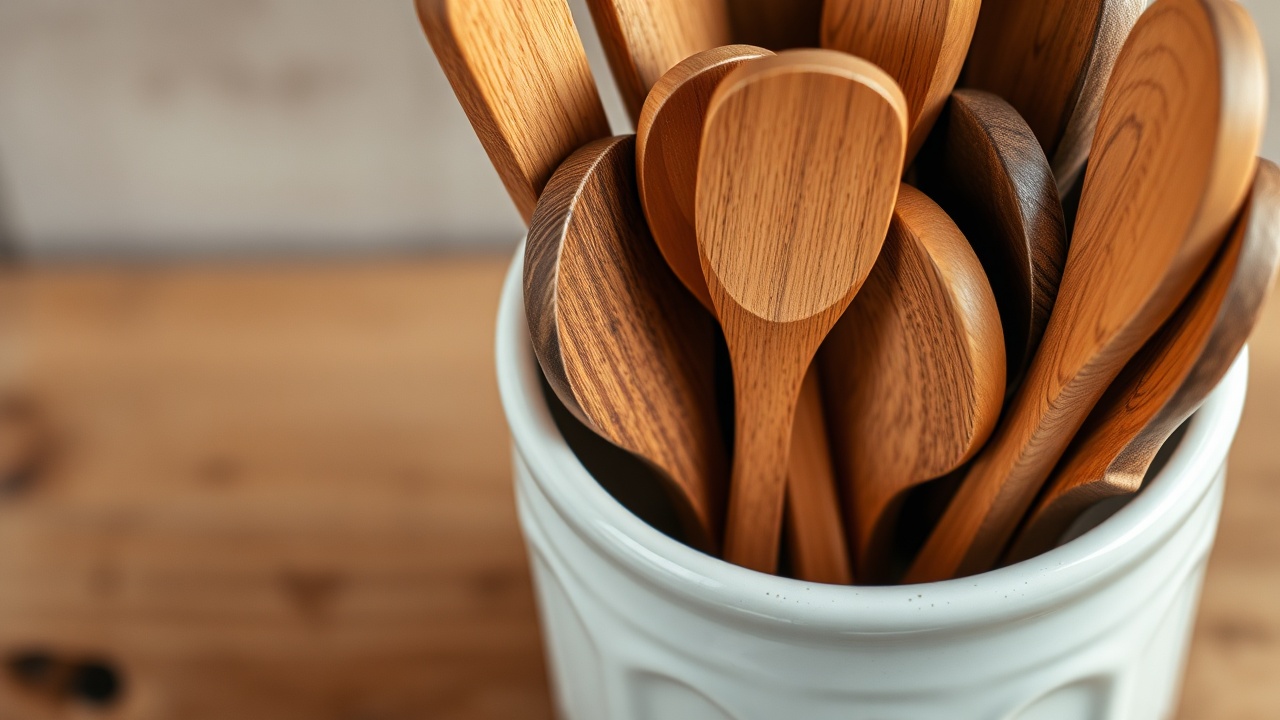
The choice of wooden kitchenware is directly linked to questions of ecology and the conservation of forest resources. Wood is a renewable resource, but only on condition of sound forestry management. When buying, it is worth paying attention to the marking of the raw material. For example, the FSC (Forest Stewardship Council) certificate confirms that the timber comes from forests where responsible reforestation is practised and where felling does no harm to the ecosystem.
The sustainability of wood also lies in its complete biodegradability. At the end of its life cycle, a wooden spatula or board will not pollute the environment for centuries the way plastic does. It can be recycled, burned as fuel or simply turned into compost. This makes wood an ideal material for the Zero Waste concept.
It is also important to consider the geographical origin of the timber. Local species (oak, birch, ash) have a smaller “carbon footprint”, since their transport requires less energy than exotic wood from South America or South-East Asia. Supporting local craftspeople also contributes to the development of a sustainable economy and the preservation of traditional crafts.
Durability is also an aspect of ecology. The less often kitchenware has to be replaced, the fewer resources are spent on producing new items. That is why buying a single expensive but high-quality end-grain board made of hardwood is more eco-friendly than replacing cheap bamboo or plastic equivalents every year. Quality wood, with proper care, serves for decades, only becoming more beautiful over time as it acquires a noble patina.
Using offcuts of timber to produce small items (spoons, trivets, handles) makes it possible to minimise waste at woodworking enterprises. Many modern brands make this their philosophy, creating unique designer pieces out of what was once considered a reject or a production waste. This approach uses every centimetre of a valuable natural resource as sparingly as possible.
Restoration: how to bring old wooden kitchenware back to life
One of the main advantages of wood over other materials is its repairability. If a plastic board has become covered in deep scratches or stains, all that is left is to throw it away. A wooden item, on the other hand, can be almost completely renewed, restored to its original appearance. The restoration process requires no special equipment and can be carried out at home.
The first stage of restoration is deep sanding. Using sandpaper of various grits, the top damaged layer is removed. You should start with a coarse grit (80–100 grit) to remove deep cuts and darkening, gradually moving to a finer one (180–240 grit) to achieve perfect smoothness. Sanding must be done strictly along the grain, so as not to leave crosswise scratches that would be noticeable after oiling.
If cracks have appeared on the item, they can be filled with a mixture of the fine wood dust left over after sanding and a special water-based woodworking glue. Once it has set, the spot is sanded flush with the main surface. For large cracks in cutting boards, “butterflies” are sometimes used — wooden inlays that mechanically draw the edges of the split together, turning the defect into an original design element.
After sanding and cleaning off the dust, the wood must be re-impregnated with a protective compound. As with treating a new item, a multi-layer approach using mineral oil and wax is recommended. After the final layer is applied, the item should “rest” for 12–24 hours until the compound has fully polymerised or been absorbed. This renewal process not only restores the beauty but also brings back the hygienic properties of the material.
It is important to remember that wood can change colour under the influence of sunlight (fading or, conversely, darkening) and from contact with staining products such as beetroot or turmeric. Regular restoration helps to maintain an even tone on the surface. In addition, the process of caring for wood has a kind of meditative effect, allowing a person to build a closer connection with the objects of their daily life.
Thus, wooden kitchenware is a long-term investment in the comfort, health and aesthetics of a kitchen. Maintaining a balance between the right choice of species, quality manufacture and regular care allows you to enjoy all the advantages of this unique natural material without compromising its wear resistance. In a world of mass consumption, such things become islands of stability and genuine quality.





